Me and the early moderns

July 10, 2020

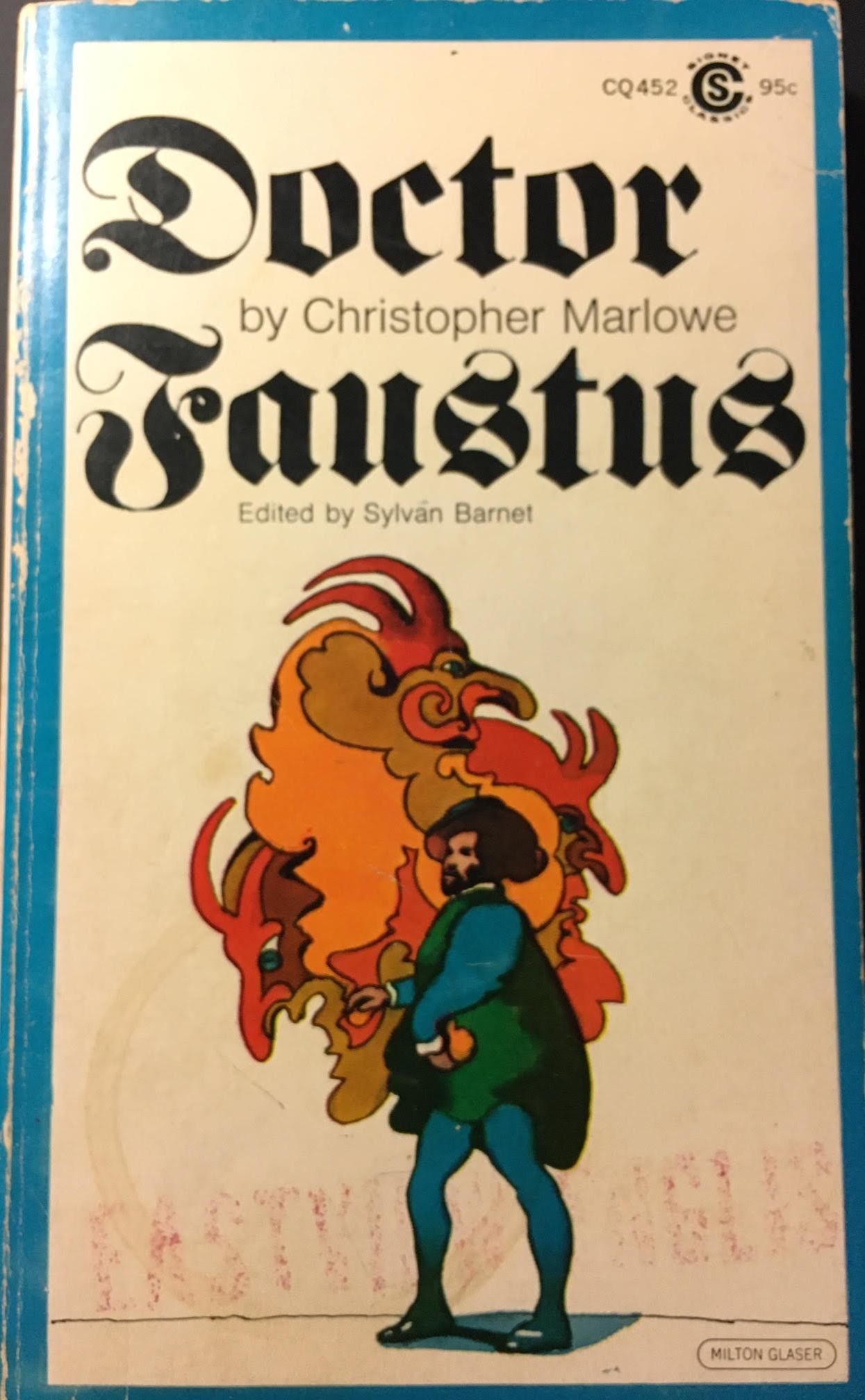
So, I promised to look back at why I’ve embarked on a self directed study of the Early Modern dramatists in English, Shakespeare’s contemporaries. I think my first exposure was back in high school when I had about Doctor Faustus and I read Marlowe’s play. unnamed I recall being actually frightened by it. It must have been the Faustus’ ultimate fate that I found alarming–the knowledge that salvation was no longer available to him.

I saw a production of the Shoemaker’s Holiday in Toronto, Toronto Arts Productions at the St. Lawrence Centre I think it was, and recall almost nothing about it. I believe there was an actor playing Queen Elizabeth, and she was stately and severe but guffawed. I’m pretty sure that I understood none of the story.

I don’t recall much mention of the Early Moderns during my university days. We were told that Shakespeare was working within an environment of talented and popular competition, but other than Marlowe, I don’t recall other names being mentioned. I knew there were other plays, because I know The Shoemaker’s Holiday existed.

Over the years, one has heard the stories about who wrote Shakespeare’s plays. Various names crop up, and I was never interested enough to pay much attention (thinking the whole thing a crackpot conspiracy theory that doesn’t even have the decent scandal to justify it) but heard some of the names of the contemporaries. I did visit Edward de Vere’s castle once, because it was near my brother-in-law’s home and made for a nice outing.

So I had a vague sense that the world of the early moderns was there, it was simmering, and possibly interesting. A few years back, I attended a reading of The Spanish Tragedy hosted by David Prosser of the Ontario Stratford Shakespeare festival, and it was great fun. I knew more by then and that The Spanish Tragedy had more that a little influence on Hamlet.

A Little over a year ago I did a play with the University of Toronto’s Poculi Ludique Societas, The Dutch Courtesan, an 1605 city comedy by John Marston. As an undergrad I’d seen a couple things from this group: Everyman; and a complete staging of the N Town Cycle. They seemed like a right raucous crew. The production was part of a larger academic event and is somewhat recalled by the website above.

What I expect to get out of this study: I’ve been making the same joke for years, saying reading Shakespeare’s contemporaries is valuable because it reminds how much better he was than his competition. There’s something to that, but it’s not entirely true. What I hope to find are the contexts within which Shakespeare was working, many of which he did not devise. As an example, the use of pageant or parades as dramatic devices, or the matter of belief with regard to ghosts and their depiction. While I believe that Shakespeare reigns supreme with regard to creating characters with deep and distinctive psychologies, I am wondering why he decided to put THAT on the stage, when the competition was concerned with other things. Clearly is was an exciting time for innovation and experimentation, but a theatre audience can only be pushed so far. They have to be lead to things. I’m not so interested in the mindsets of the various classes of Elizabethan or Jacobean societies, but it what they would and could accept in the drama.

I have a particular interest in the uses and styles of humour as well.

Test Resume Layout

February 2, 2018


Glasses provoke memory

March 15, 2017

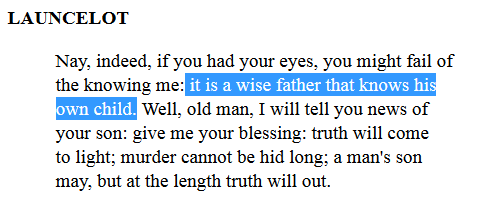
These are the glasses I wore in Sleuth all those many years ago. In Act 2, I returned as Inspector Doppler, a costume change, stippled makeup, some crepe hair, a west country accent and these glasses. Although the film was well known and so, audience members should have known that my character was in disguise, my father didn’t recognize me until the character reveal. Calls to mind Act 2 Scene 2 of Merchant of Venice:

Notes on Oedipus Rex at Stratford- July 16 opening

July 18, 2015

This is not a review, just assortment of points, mostly personal.
While I didn’t enjoy this production, it did give me much to consider.

I have read published reviews and comments and am surprised by the favorable ones. I think what I am reading is people sensitive to and commenting on the excellence of Sophocles’ play. I guess what I have is a sense of what is can look like staged by this company, and I feel there were opportunities missed.

Was looking forward to this for these reasons: enjoyed the Stratford Elektra a couple years back, have never seen Oedipus live, and because Daniel Brooks was directing. I knew Daniel briefly when we were undergraduates at U of T, and performed in a play with him. Thought we’d see all kinds of inventive staging applied to this classic. Further excited by the involvement of Camellia Koo whose work I’ve admired for her way of serving the play and not just providing a strange design for the sake of looking interesting. She also does a full design, not just set.

In attendance for the opening that I could see from my seat were: Globe critic Kelly Nestruck; Festival AD Antoni Cimolino; and actor Colm Feore. I now know, based on Antoni’s location, which is the choicest seat in the TP theatre.

I bought a last minute discounted ticket and drove (2 hours each way) to the opening. Lesley didn’t want to go.  On the way to the theatre I listened to the audio of the 1950’s Stratford production starring Douglas Campbell, by way of review and preparation. Mannered, old fashioned and stuffy, it did the job reminding me about the script.

The five minute hold didn’t seem necessary, but one sound effect, lx dim,  and we were off. Auspicious beginning. Character in clad in red robes, a shade of red that I think of as Cardinal Red, “incensed” (distributing smoke about) the playing space with a modern smoke machine.  Those machines are now shoe box size.  It was beginning both ancient and contemporary.  O enters in a cream suit and asks the audience simply “Why are you here?” A couple of lines later it becomes clear that these words are Sophocles’, and that we are being addressed as though we were the chorus. (Who are suppliants to O). It also becomes clear that this translation has been de-poetrified, it is very pedestrian prose. O paces some, because we don’t answer, and then sits to listen to the Priestess (also seated) who is now incensed (very angry) about the plague and wants O to do something. It is not clear why she is so angry about this because that is not what Sophocles wrote, and there is no other business to explain her ire. Perhaps in this productions yelling will indicate intensity. God I hope not.

Well, O seems a bit miffed about this treatment and explains that he’s already on the task. He’s almost sarcastic, and does this speech pacing I believe. He does a lot of pacing around the rectangular perimeter of the TP stage. (BTW-I thought Daniel Brooks attended the same lecture on Oedipus by Margaret Visser that I did while we pursued our Drama BA’s. She explained at great length about the importance of the circle as the central image in Oedipus. This was over 35 years ago and I still remember parts of it). I begin to notice that this prose translation, besides being rhythmically benign, is also longer than verse versions, as the translator wishes to convey so much of the original, compressed verse.

About 20 – 25 minutes into the show, the fellow two seats from me began to snore. Fortunately he woke himself up and he managed to fight off the zzzz’s the rest of evening.

Creon returns and seems ready to leave again immediately. He doesn’t want to say what he’s learning in front of us (we’re the Chorus, remember?) He lays it out, and the plot of course takes off.

The on stage Chorus entrance was dramatic and ritualist in its slowness. Each person approached a silver platter and laid paper money in it. While consistent with the notions of sacrifice and offerings paid to gods, this isn’t in the text, and the I was wondering if Brooks intended some kind of dig at Christianity or at modern Greek economics. The Chorus leader looked unreasonably like Angela Merkel to me. Chorus members then self-applied some clown white to their faces in a ritualistic manner to …. to… I don’t know why they did that. When completed, the Chorus was easily identifiable by these markings, but it was awfully abstract. Anyways, they were already identifiable by their grey business attire.

Periodically, at least three times, the lights flickered as though a distant thunderstorm threatened. It was a small detail and I found it more distracting than anything else. I recalled Theatre Centre type electrics (some of which I was responsible for at 666 King St. location) and how questionable the lighting grid can be in alternative spaces. Also distracting were the regular drum thuds that persisted throughout: this was the most consistent part of the soundscape. When it started I was glad because I thought it signalled a rhythmic ground against which the play (and especially the chorus). No, it wasn’t. I found that I tuned it out after a while.

Loved the entrance of Tiresias and his costume and performance. Here it made some sense for an actor to be seated, but he didn’t stay so.

The Chorus was behaving with a reduced set of techniques. Very little choral speech, because odes were turned into solo speeches made into a microphone. (Note to visiting directors at Stratford: your actors have trained for years so they can be heard clearly in all settings and situations. They do not need to be amplified.) I’m not sure what Brooks intended, but to me, they looked like audience members posing questions at a public meeting. That made all the involved invocations to the gods seem ridiculous. On the whole, very still and non-descript, sometimes in prolonged freezes. Some of these performers were the same ones who’d energized last year’s Mother Courage, and here they were seated, staring into the middle distance. Here I felt the director’s creativity was missing: give these great performers something to do. It was akin to watching finely tuned sports cars in stop and go city traffic. Frustrating.

Jocasta’s (Yanna McIntosh) performance energized every scene she was in, from her entrance right through her final exit. She seemed perfectly at home with the task of mingling a non-realistic text with a realistic emotions. I don’t think anyone else in this production came near to her in this.

Lally Cadeau’s messenger entered with a pail and I thought “charwoman.” She sat herself down and spoke one of the most compelling speeches in western literature in some kind of accented English. It may have been English as spoken by someone whose first language is Greek, but I couldn’t be sure. I thought it sounded more like one of Luba Goy’s crazy Ukranian ladies. Honestly, while I listened, I took nothing in, because I could not answer these questions: why a charwoman, why the accent, and what actor in her right mind elects to sit for a speech like this?

Nigel Bennett’s shepherd used a modified dialect too, and he elected the old British standby for rustics: west country. Arrgh, he be’s a roight Summerzet shep’erd, he be. Oh yah, character is seated.

Messenger from Corinth: seated for much.

We had to wait until about the 90 minute mark to find out what the plastic sheet was for. O, buck naked and much bedaubed in stage blood, crashes through it and it falls to the ground. It is a great effect. Not so great is watching our naked O unpack his thoughts. It’s an uncomfortable duration until he is covered with Creon’s coat. I looked over at Colm Feore a couple of times and he was very rapt. I imagined that he was very taken by the total nakedness of the performance; he more than most of us knows what Gord Rand was going through–centre stage and absolutely no tricks possible.

Ismene and Antigone entered weeping and I found their huddled grief very affecting.

At times, O’s intonation and cadence put me in mind of, and this is going to seem weird, Eric Peterson. I think of him as possessing an unmistakable Canadian accent, and Gord Rand, at times, sounded like him, I thought, right down to raspy-harshness of some upward inflections.

Two omissions I noted: The messenger from Corinth reminds the Theban shepherd of their shared time together. This was cut. I thought it an essential point, in terms of the plot and their relationship. Also, speeches were snipped from the end, including the all important “call (or “judge”) no one happy who is still alive”
First thoughts on Go Set a Watchman

July 16, 2015

Still suspicious that it’s a hoax. No overt anachronisms (unless Uncle Jack’s use of “white supremacist” was one). That it is so closely tied to TKAM in theme and even who the characters are, that there are so few additional characters–it’s the kind of work a person tasked with creating an explanation for why Harper Lee returned to live in Monroeville would write.

Part of the opening 100 pages could have been written by Alice Munro because it seems so much like Munro’s world of tiny observations on the trials of being a woman in the 1950’s.  Lacks Munro’s facility with language, of course, and those startling leaps that create moments of discovery. When I read this I thought what pleasure Harper Lee must have derived from Munro.

Ending. Pop psychology tells me it’s about a something called an accommodation. While unsatifactory on many levels, it does satisfy on one level: the book does seem to be about big and little themes, personal and public (political and social) issues simultaneously, and about the kind of consciousness that encompasses that.  In this, it is Huck Finn again. It underscores the serious public intentions of TKAM,

Visiting Uncle Jack to have it all explained to you reminded me of Winston having things told him by Obrien in 1984, or Montag hearing from Faber and Beatty all the unpleasant truths of the world in Fahrenheit 451.

Jean Louise’s outsider status is important throughout, and is it the writer’s stance, her lot in life (i can’t beat him, I can’t join him) and is it a layer covering another kind of outsiderism: lesbianism? A question I can’t either shake or answer, and usually wonder if it even matters.

Will be the source of countless theses–i feel sorry for English profs. It is a fascinating document when considered as part of a writer process when put beside TKAM.  It does not resolve the issue of Capote’s contributions to TKAM though.  That is, it’s not the case that this is so strong and clearly in the same voice with the same strengths as TKAM that one can say they were the result of the same hand.

There appear to be minor errors that you’d expect an editor to have corrected. ?

Some experimentation with voice–the streams of dialogue rendered in the Coffee episode for example. Nice to see.

Owen Meany says about teachers

June 13, 2015

I have mis-remembered this. I can’t find this in the book again. I thought that in John Irving’s A Prayer for Owen Meany there was a passage where Owen tells the narrator to be an English teacher. Owen goes on to say that it’s the easiest job in the world because all you have to do is notice things, and the author has already done that for you.
Can’t find that. It does sound like the kind of thing Owen Meany would say, doesn’t it?

Canada’s spies and the law

February 28, 2015

I happened to be reading John Sawatsky’s 1980 book, Men the Shadows: The RCMP Security Service when the government introduced their anti-terrorism bill C-51. The book provides a history Canadian security work in the 20th century until the creation of CSIS, an agency that grew out of people’s upset with exactly how the RCMP was going about their business. Because RCMP operatives were regularly caught breaking the law and behaving without regard for civil liberties, the alternate agency, CSIS, was created.
So what does a 35 year old book have to tell us about our current situation? Quite a lot about the human and political and legal aspects I think.
First: spies have a history of breaking the law and behaving in ways that the public and government find intolerable. The key events that Sawatsky details occurred in the 1970’s, many of them the result of the October Crisis of 1970. People found RCMP so egregious, that the tasks of national security were taken from the them and the force was disgraced.
Second: “Disruption” is a very nebulous term, and has meant everything from delaying mail to beatings and bombings. At times it has been carried out without any intention of gathering intelligence or interrupting hostile activity, but for the sake of just sending a warning. Some of the groups thus warned were political organizations with no ties to terrorism.
Third:The paramilitary structure of the RCMP contributed to some of its worst excesses. The hierarchical command structure and insularity meant that actions were never questioned by the people who had to carry them out. In other words, if we count on the police to police themselves, we’ll be mistaken. That’s not something they are set up to do.
Sawatsky devotes a section in Chapter 19 to the matter of illegal activity on behalf of intelligence gathering and those fighting enemies of the state. Here are points from that chapter:
*.*“From dozens of interviews, both with Mounties who have performed illegal acts and with civilians who have watched them, I am convinced that they do not see their acts as illegal. Such methods are accepted as the basic tools to protect Canada’s security. Security Service members do not philosophize about the deed; it a practical matter. When challenged, most members fall back on the old paramilitary excuse the the actions are approved by their superior officers and therefore are not illegal.”
*.*“They believe their acts are morally right and view impeding legal statutes only as technical barriers, not ethical ones. … They believe the lawmakers, although they want to preserve order, as so misinformed and consumed by politics that the results of their legislation does not meet their objectives.”
*.*“At no time did the Security Service make a formal decision to condone illegal activity It was embraced through a series of gradations over a number of years. . . . Without ever realizing it the RCMP had adopted illegal activity as a fundamental investigative technique.”
Sawatsky also notes in this chapter that politicians took measures to ensure that they did not know about illegal activity so they would not have to do anything about it. Officers involved expected that if caught there would not be criminal charges, and if the worst happened (charges and imprisonment), that their families would be taken care of. This matter was addressed by RCMP Commissioner W. L. Higgit in a August 1970 memo titled “RCMP Protection for Members Engaged in Sensitive or Secret Operations.” Sawatsky includes the entire text of that document. One excerpt:
*.*“8. It must always be born [sic] in mind, or course, that where a member is directed to perform a duty which may require him to contravene the law for any purpose or where the means required to achieve a specific end can reasonably be foreseen as illegal, a member is within his rights to refuse to do any unlawful act.”

What happens when our spies are freed from all restrictions and nothing is illegal? We can’t even rely on their own consciences to restrain them.

My week to get things wrong

October 23, 2014

Oct 22 2014
+Spent last weekend in Ottawa while Lesley attended the CODE conference. We were downtown, and when I walked the mostly empty streets I thought how dull the town was, and there was nothing for a weekend tourist in October. I felt proud while passing the American Embassy that here was a spot where Americans didn’t have to worry about violent attacks. I saw one guard on duty on the steps of the Embassy; she was behind a fence, but she was mostly bored and inattentive, pacing in a small circumscribed area with her head down not even glancing about at her surroundings, and that seemed like a good sign. There were many vendors in the Byward Market area selling pumpkins, and what did I find on Spark St. but full fall country displays with hay bales, pumpkins and other gourds. Surely, I thought, anywhere else these would be pilfered or taken up and smashed, but not in Ottawa. When I went past Parliament Hill, the few tourists there were mainly milling around the Peace Flame (which is totally cool)
Twice I overheard conversations in restaurants-both were about religion. Different restaurants, different days, different people, but the same topic.
And today, on those same streets all hell broke loose.
+I had been trying to get a new job and have been unsuccessful. I found out yesterday that I didn’t even know all the duties of the job, and I’m pretty sure that I made a fool of myself in the job interview because of that. Small wonder the interview team found me unacceptable.

Extant and the American Mythos

October 5, 2014

Before launching into space to save mankind in a perilous mission, Hailey Berry’s character gets suited up. An authoritative voice intones over the scene, explaining the purpose and plan and the import. He finishes with ”

If you’re the praying type, say a prayer for Dr. Woods.  If you’re superstitious, cross your fingers, throw a pinch of salt.  If you don’t believe in anything, believe in her.

” I thought how very American. Then I realized, no, it wasn’t simply an American point of view, it was THE American point of view, which can be summed up thusly:
*the USA is the highest achievement of civilization, of a pool of global effort, and as such, is divinely ordered, inspired and maintained. Of course an Almighty being would want to oversee an astronaut;
*All who will not and cannot support the preceding must still have feelings and wish to support the project. They are reduced to private acts of goodwill, but as such, create an environment conducive for success. They will support the collective good.
*Should anyone fall outside either of preceding categories, they are invited to participate by re-iterating the primo American myth, the astonishing and transformative power of the individual. That in itself is worthy of faith.
I can’t imagine anyone other than an American who could pen those lines.  On one level, it is a hierarchy that descends in importance: gods; spirits; individuals. On the other hand, the hierarchy ascends: gods and spirits receiving totem-like observance, then the all important individual hero

Thought occassioned by Michael Frayn’s Copenhagen

July 27, 2014

One of the ideas presented in the play is that of a student seeking praise or affirmation from his former teacher. I think that’s a powerful motive for many people, and that operates in a very unexamined fashion. But what terms do we define success? Well, one is the judgement of teachers and how many of us spend much of lives working to meet the expectations of teachers who are no longer part of our lives? And what do teachers use as their yardsticks and barometers of success. You guessed it, the praise and affirmation of their teachers, and so the whole thing regresses into the past, to the judgements of nameless, inferior and ignorant pedagogues of the past.
Now capitalism has other ways of measuring success, and the making the sale is an imporant one. Here we can esteem the work of advertisers who manipulate perceptions and contexts to accomplish that very thing. They, like Heisenberg and Bohr, re-frame our existence and then show us how we had it all wrong.